Triboelectric Attenuation Induced by Lubricant Aging and Its Application in Oil Condition Monitoring
FAYETTEVILLE, GA, UNITED STATES, September 30, 2026 /EINPresswire.com/ -- This article explores the influence of
Press Release Disclaimer: This is a press release distributed through the XPR Media network. It has not been independently verified by our newsroom.
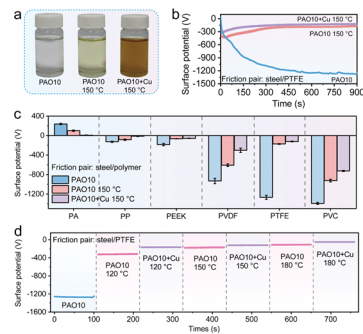

FAYETTEVILLE, GA, UNITED STATES, September 30, 2026 /EINPresswire.com/ — This article explores the influence of lubricating oil aging on the triboelectric behavior of the steel/polymer interface. The study systematically analyzes the relationship between oil aging and interfacial charge evolution by subjecting lubricating oils such as PAO10, PETO, and 500SN to high-temperature aging, combined with friction experiments, surface potential testing, and characterization of the oil’s physicochemical properties.
Interfacial static electricity generated during friction is highly sensitive to the interfacial state, affecting not only tribological properties but also possessing the potential to monitor the state of the friction interface. In actual mechanical operation, lubricating oils age due to factors such as high temperature, oxygen, and metal catalysis, resulting in continuous changes in their chemical composition and physicochemical properties. However, a clear understanding of how lubricating oil aging affects the evolution of interfacial triboelectricity remains lacking, limiting the application of triboelectric signals in lubrication condition monitoring.
Previous research has primarily focused on the influence of lubricating oils with different dielectric properties, adsorption properties, and viscosities on interfacial triboelectricity, or on changes in lubrication performance after lubricating oil aging. However, systematic research is still lacking on how changes in the physicochemical properties of the same oil during aging affect the evolution of interfacial charge, and the underlying mechanisms.
This study focuses on the influence mechanism of lubricating oil thermal aging on the triboelectric behavior of the steel/polymer interface, using PAO10 as the main research object. By preparing lubricating oils with different aging degrees, the potential of the friction surface was measured, and the physicochemical properties of the oils, such as wettability, dielectric properties, and resistivity, were further characterized to establish the intrinsic relationship between oil aging, changes in physicochemical properties, and the evolution of interfacial charge. Simultaneously, the universality of this law was verified using PETO and mineral oil systems, and the feasibility of using the triboelectric interfacial potential as a signal characterizing the aging state of oils was further explored, providing new ideas for intelligent lubrication and mechanical health monitoring.
References
DOI
10.3724/trad-20260012
Original Source URL
https://doi.org/10.3724/trad-20260012
Funding Information
This research/work received funding from/ was supported by the Key Research and Development Program in Shandong Province (No. SYS202203), the National Natural Science Foundation of China (52275219, 52305233, 52205233), the Natural Science Foundation of Gansu Province (23JRRA610), the Qingdao Natural Science Foundation (No. 25-1-1-97-zyyd-jch), the Shandong Natural Science Foundation Youth Program (No. ZR2025QC1124), the National Postdoctoral Research Fellow Program (Grant No. GZC20250930).
Lucy Wang
BioDesign Research
email us here
Legal Disclaimer:
EIN Presswire provides this news content “as is” without warranty of any kind. We do not accept any responsibility or liability
for the accuracy, content, images, videos, licenses, completeness, legality, or reliability of the information contained in this
article. If you have any complaints or copyright issues related to this article, kindly contact the author above.

Media gallery