Grimes Paint & Body Publishes Consumer Guidance on Body Panel Repair vs. Replacement
Forney, TX - September 16, 2026 - PRESSADVANTAGE - Grimes Paint & Body has published new September consumer guidance
Press Release Disclaimer: This is a press release distributed through the XPR Media network. It has not been independently verified by our newsroom.
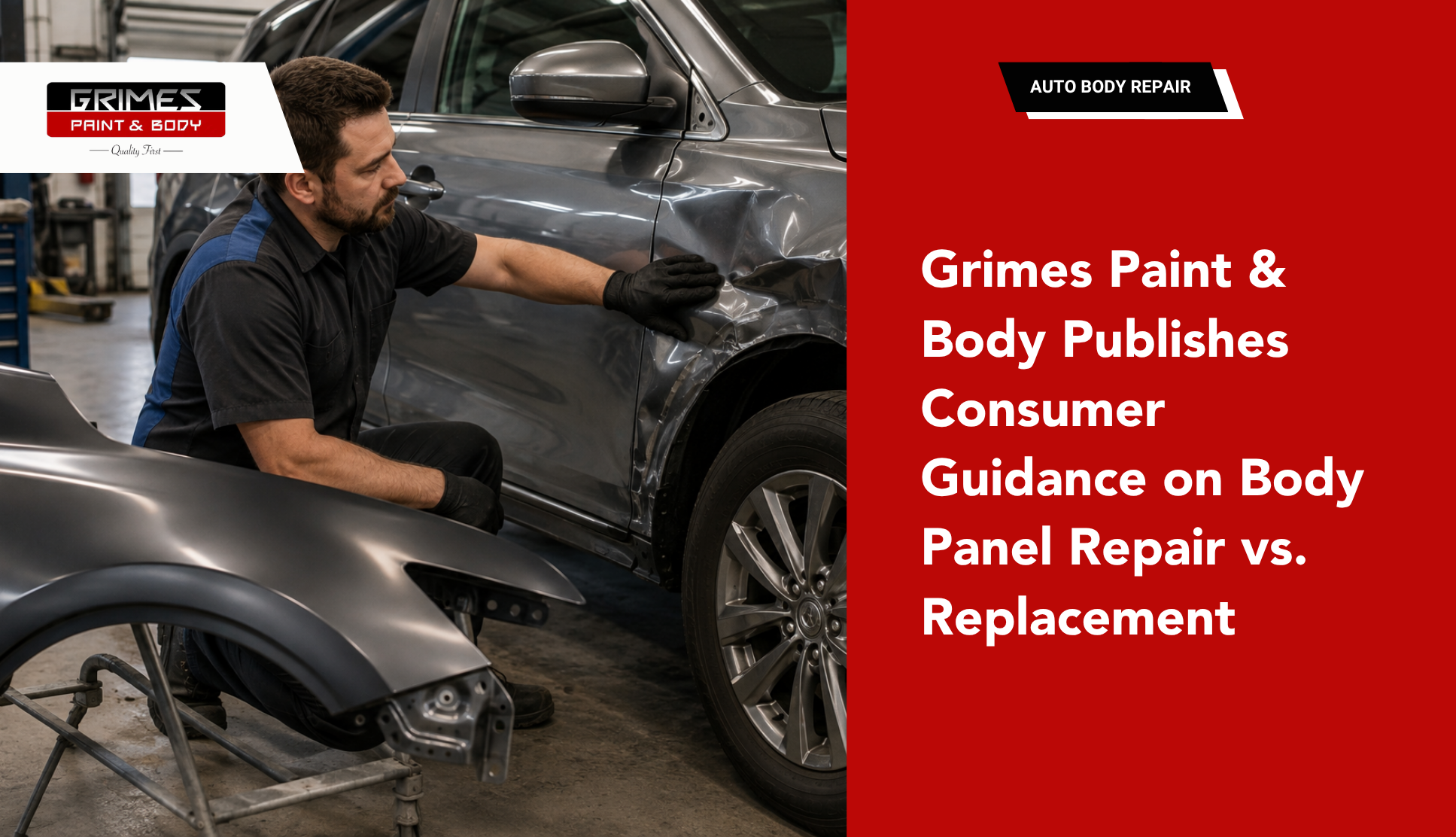

Forney, TX – September 16, 2026 – PRESSADVANTAGE –
Grimes Paint & Body has published new September consumer guidance explaining how collision repair professionals evaluate whether a damaged body panel may be repaired or requires replacement.
The new resource organizes the decision around five primary considerations: damage characteristics, panel construction, accessibility, manufacturer repair information, and the condition of attachment areas and surrounding components.
The September publication addresses a common collision repair question by explaining why the visible size of a dent or damaged area does not independently determine whether repair or replacement is appropriate. Two panels with similar-looking damage can require different procedures because their materials, design, location, and condition may differ.
Additional information about body panel evaluation and repair is available through Grimes Paint & Body’s Auto Body Repair resource.
Damage characteristics are one of the first considerations discussed in the new guidance.
Collision damage can include dents, creases, tears, punctures, deformation, damaged edges, or displaced attachment areas. Where the damage occurs can be as important as its overall size.
For example, a relatively small damaged area near a panel edge, body line, reinforcement, or attachment point can present different repair considerations from a larger dent in a more accessible portion of a panel.
The second consideration is panel construction.
Modern vehicles can incorporate different grades of steel, aluminum, plastics, composites, adhesives, and other materials. Because these materials have different characteristics, a repair technique appropriate for one component cannot necessarily be applied to another.
Even panels constructed from similar materials can have different repair limitations because of their design and function.
This makes identification of the vehicle and affected component an important part of determining the appropriate repair approach.
Manufacturer repair information provides another part of the decision.
Automakers can publish technical procedures addressing whether particular components or areas are repairable and how replacement should be performed when required. Depending on the vehicle, this information can address repair limitations, attachment methods, joining procedures, measurements, and other technical requirements.
For consumers, this helps explain why a repair performed on one make or model does not automatically establish how similar-looking damage should be handled on another vehicle.
More information about vehicle-specific repair planning is available through Grimes Paint & Body’s Collision Repair resource.
The September guidance also identifies accessibility and surrounding construction as considerations.
Exterior damage does not always reveal everything located behind a body panel. Reinforcements, brackets, fasteners, mounting areas, and adjacent components can affect the available repair approach.
In some cases, additional information becomes available after appropriate access to the damaged area is established. Those documented findings can then be incorporated into the repair plan.
Attachment areas can be especially relevant when replacement is being considered. Vehicle components may be connected using welds, adhesives, rivets, bolts, mechanical fasteners, or combinations of joining methods.
When replacement is appropriate, manufacturer information can identify procedures for removing and installing the affected component. This is why panel replacement can involve more than simply exchanging one visible exterior part for another.
The September publication also explains where paintless dent repair can fit within the repair-versus-replacement discussion.
Certain dents with intact paint may be candidates for paintless dent repair when the material, damage characteristics, and accessibility are appropriate. Other conditions, including damaged paint, sharp creases, stretched material, or limited access, can affect whether that method is suitable.
The availability of PDR does not change the broader principle of the guidance: the repair method is selected according to the documented condition of the individual component rather than the apparent size of the dent alone.
Modern vehicle technology can add further considerations when exterior components are involved.
Cameras, radar equipment, parking sensors, wiring, antennas, and other electronic components can be located in or near bumpers, mirrors, doors, quarter panels, liftgates, and other collision-prone areas.
Their presence does not automatically establish that scanning, calibration, or another electronic procedure will be required. When relevant, those requirements are identified according to the vehicle, affected systems, repair operations, and applicable manufacturer information.
The new guidance also addresses why an initial repair estimate and a completed repair plan may not always contain identical information.
An initial assessment reflects conditions that can reasonably be documented at that stage. When appropriate access or disassembly reveals additional collision-related conditions, those findings can provide new information for the repair plan.
For consumers comparing the terms repair and replacement on collision documentation, Grimes Paint & Body’s September publication emphasizes that neither term independently indicates a better repair.
A panel identified for repair may have damage and construction that permit the appropriate repair procedure. A panel identified for replacement may have documented damage, manufacturer limitations, attachment-area conditions, or other factors supporting that operation.
The central takeaway is that there is no universal dent size or damage threshold that determines the correct operation for every body panel.
By publishing the September guidance, Grimes Paint & Body is providing consumers with a more concise framework for understanding panel repair decisions: evaluate the damage, identify the component and material, consider accessibility and surrounding areas, review applicable manufacturer information, and select the operation supported by the documented conditions.
The information is educational and does not determine whether a specific component should be repaired or replaced without evaluation.
About Grimes Paint & Body
Grimes Paint & Body is a family-owned collision and auto body repair business serving Forney and surrounding Texas communities. The company provides collision repair, auto body repair, paintless dent repair, RV repair, and related vehicle restoration services from its facility at 11804 N Profit Row, Forney, TX 75126.
###
For more information about Grimes Paint & Body, contact the company here:
Grimes Paint & Body
Edward Grimes
469-728-7210
info@grimespaintbody.com
11804 N Profit Row, Forney, TX 75126